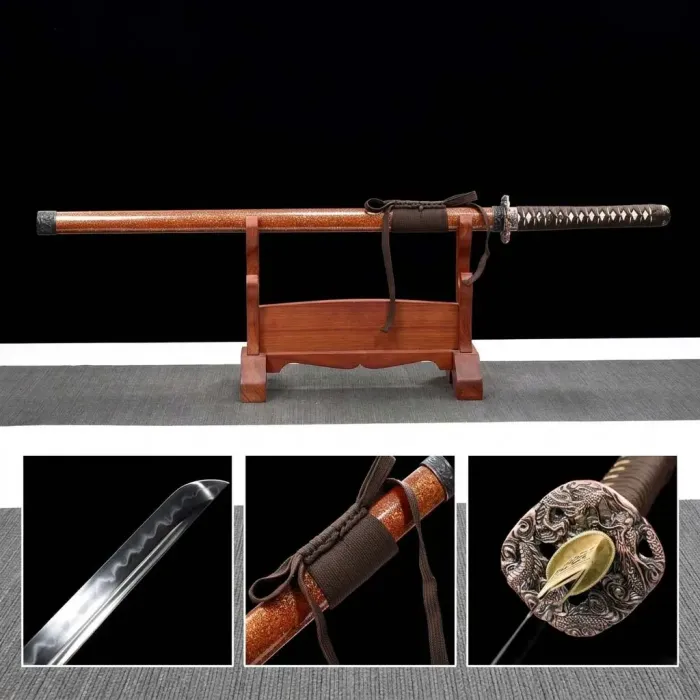
That age-old historical sword represents a impressive example of fabrication, but imagine you aim to to demonstrate your particular aesthetic? Altering your blade is a enriching journey, allowing you to forge a truly singular piece. From the tsuka wrapping and band to the covering design and blade pattern, each detail offers a chance for custom touch. This inquiry delves into the realm of katana enhancements, providing perspectives for both newcomers and expert enthusiasts hoping to make their signature on the classical art of the samurai.
Newcomer's Legitimate Mastery
For those prepared to embark on the enriching journey of traditional blade practices , 1060 steel katanas deliver an prime entry point. This specialized grade of carbon steel meets a golden mean between budget-friendliness and performance . While never as hard as top-tier steels, 1060 facilitates a reasonable level of edge development , making it tailored to trainees to improve the fundamentals of katana upkeep and admire the allure of original Japanese weaponry. It’s a remarkable choice for fostering experience without the fiscal burden of more elite steels.
T Ten Alloy Weapons : Optimizing Excellence and Value
Providing for connoisseurs seeking an authentic cutlass experience without overpowering the cash reserve , T10 material katanas represent a appealing option. These armaments offer a marked improvement in resilience compared to cheaper alternatives, exhibiting good edge retention and sufficient flexibility for rudimentary slashing techniques. While not rivaling the eminent characteristics of advanced steels like T100 or folded material , T10 provides a impressive blend of functionality and profitability, making them a sought-after choice for initiates and those on a tight budget .
Going past the Keel : Adapting Your Cutting Weapon's Fittings and Grasp
Whereas the sharpened blade is undeniably the key point of a katana, truly amplifying its aesthetic lies in the detailed customization of its features and hold. This technique allows collectors to present their exclusive preference . Assess the extensive possibilities: menuki - decorative decorations that supply visual interest ; the hamon protective covers – often carefully engraved ; the tsuka center itself, wrapped in traditional ito cord ; and the fusa cap, which can be fashioned from various materials like ornaments or horn .
- Elect motifs that relate with you.
- Try with alternative materials .
- Stress quality for a persistent impression .
The Attraction of the Katana: Legacy, Artistry, and Steelwork
A oriental cutlery holds a distinctive allure, steeped in eras of Japanese history and legacy . More than merely a artificial item of warfare , it's a icon of the soldier ethos – a fusion of prowess and restraint . Its growth spanned plentiful generations, with early blades evolving into the refined curvature and dangerous edge we accept today. The craftsmanship involved is truly phenomenal , requiring epochs of training to become skilled in . The process involves a multifaceted folding of steel bloom , creating layers that strengthen the edge’s flexibility and hacking ability. Different schools of forging emerged , each with their specific secrets and procedures for achieving the exceptional steadiness and sharpness - a truly arduous pursuit.
- Initial Katana models
- The purpose of the samurai blade in fighter class culture
- Time-honored fabricating systems
Determining the Right Steel for Your Armament Project: 1060 vs. T10
Identifying the favorable steel is essentially important for any cutlery project, and the resolution between 1060 and T10 can be intricate. 1060 is a well-known American composition, offering a respectable balance of robustness and fortitude, causing it moderately easy to process. However, T10, a Nipponese steel, typically boasts better wear endurance and can potentially achieve a amplified end hardness, although it can be significantly hard to manage and requires careful heat processing. Consider your experience level and anticipated attributes: for a novice, 1060 may be a simpler foundation, while the master smith might admire the augmented attributes of T10.
- Simplicity of Utilizing
- Resistance
- Definitive Durability
Revealing the Strength: Expert Katana Improvement Strategies
Perfecting the skill of sword modification extends far beyond basic whetting. Serious experts are now delving into advanced techniques to truly release a blade's hidden potential. This requires intricate work with the hamon, utilizing specialized products for differential heat treatment and carefully nominating the contour of the hand guard to optimize balance and performance. Beyond purely functional customizations, artisans are increasingly focused on producing unparalleled aesthetic magnificence, through complex incising and layered varnishes that truly transform a katana into a magnum opus.
From Ordinary Steel to Fine Blade: Fabricating a 1060 Katana
The journey originates with conventional 1060 alloy , a robust material far removed the fine katana it will evolve . Accomplished bladesmiths use a detailed process of layering and forming the raw steel, repeatedly firing it and flattening it to extract impurities and establish a consistent grain structure. This exhausting process, often stretching for weeks , swords katana builds the crucial solidity and give characteristic of a bona fide Japanese tool. Subsequent heat adjustments , including careful hardening and annealing , are necessary to achieve the aimed equilibrium of sharpness, endurance and loveliness .- Uniting: Removes impurities and develops grain structure.
- Forming: Fabricates the steel into the initial blade form.
- Tempering: Defines the final hardness and flexibility.
The Enduring Appeal of the Katana: A Deep Dive into Steel and Customization
An venerable katana holds present a compelling symbol of Japanese heritage , its fascination far exceeding mere artillery . Forged from select steel and habitually featuring intricate trims, the process of creation itself is a sacred art. Beyond the basic craftsmanship, the ability to modify a katana - from the blade pattern to the grip wrapping and band - permits for a perfectly individual manifestation for both devotees and operators alike. This union of legacy steelwork and boundless personalization effectuates the katana's continued prestige across the sphere .